

Two Risks That Are Not Getting Enough Attention
The Section 48E credit is generous. It is also increasingly conditional in ways that a surprising number of developers, investors, and tax-exempt entities have not fully absorbed.
Two provisions introduced or significantly clarified under the One Big Beautiful Bill Act deserve much more attention than they are currently getting in most project conversations.
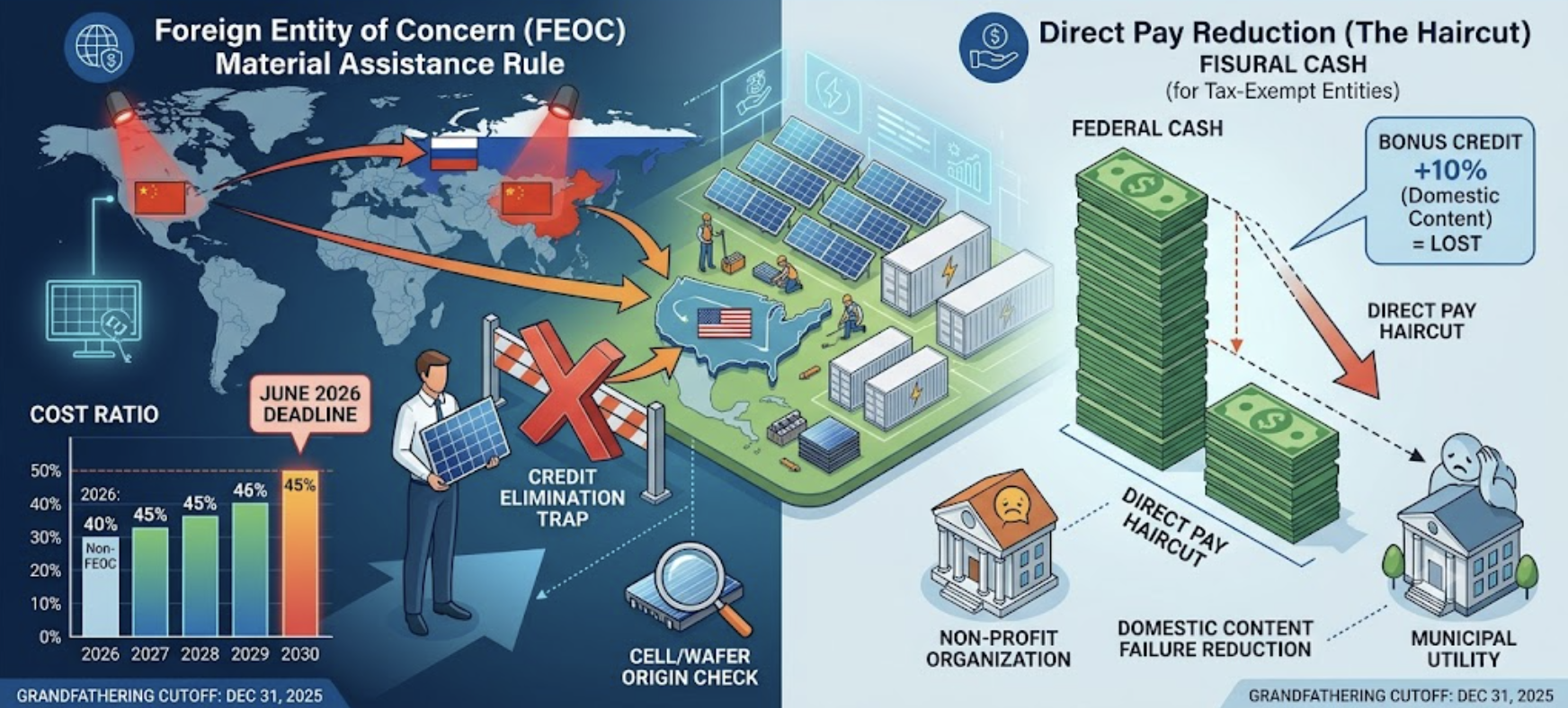
The first is the Foreign Entity of Concern material assistance rule. This is a supply chain restriction that, if violated, eliminates the Section 48E credit entirely for the affected project. Not reduce it. Eliminates it. And it does so based on procurement decisions made before the project is built - decisions that often happen before the compliance implications are fully priced in.
The second is the Direct Pay reduction - commonly called the haircut - that applies specifically to tax-exempt entities claiming Section 48E through the elective payment election. Organizations relying on Direct Pay as their primary monetization mechanism need to understand that the cash they receive from the IRS may be meaningfully less than the nominal credit value if their project does not satisfy domestic content requirements.
The reduction is not hypothetical. It is structural, and it compounds with the loss of the domestic content bonus adder.
This article explains both in plain terms, and covers what needs to happen before the end of June 2026 for projects still in the pipeline.
Part One: The FEOC Rules - What They Are and How They Work
The Basic Structure
FEOC stands for Foreign Entity of Concern. The OBBBA embedded FEOC restrictions into Section 48E to limit the role of entities tied to four covered nations - China, Russia, North Korea, and Iran - in U.S. clean energy projects receiving federal tax support.
The FEOC rules operate through three separate disallowance triggers, each with its own scope and timing.
The first is taxpayer status. If the entity claiming the Section 48E credit is itself a Specified Foreign Entity or a Foreign-Influenced Entity, no credit is allowed. This applies to credits claimed in taxable years beginning after July 4, 2025.
The second is material assistance. If the qualified facility or energy storage technology receives material assistance from a prohibited foreign entity during construction, the credit is disallowed. This rule applies to projects beginning construction after December 31, 2025. Projects that established a valid construction start before January 1, 2026 are grandfathered and not subject to this requirement.
The third is effective control. If a contract or arrangement gives a Specified Foreign Entity effective control over the facility - meaning influence over output timing, offtake decisions, data access, sourcing choices, or intellectual property use - the credit can be disallowed. Long-term royalties exceeding ten years and post-enactment IP licenses are specifically captured. Bona fide IP sales are exempt. Effective control also triggers a separate 100% recapture provision extending for ten years after the project is placed in service, for credits in tax years beginning more than two years after the OBBBA's enactment.
Who Counts as a Prohibited Foreign Entity
A Specified Foreign Entity includes the governments of China, Russia, North Korea, or Iran and their agencies; citizens or nationals of those countries (excluding U.S. persons); and entities organized in, principally based in, or controlled by any of the above. Control means ownership of more than 50% of equity, applying standard IRS attribution rules under Section 318.
A Foreign-Influenced Entity is an entity that is not itself a Specified Foreign Entity but has significant exposure to one. An entity qualifies as foreign-influenced if a Specified Foreign Entity can appoint its board members or executive officers; holds at least 25% of its equity (or multiple Specified Foreign Entities together hold at least 40%); holds at least 15% of its outstanding debt; or made an effective control payment to the entity in the prior year. FEOC status is determined annually, at the end of the relevant taxable year.
Publicly traded companies receive a partial exemption from certain Foreign-Influenced Entity rules, unless a Specified Foreign Entity has the power to appoint officers or directors. For these entities, reliance on public disclosures is permitted - except for exchanges located in covered nations. That exemption sounds like relief on paper, but it runs into a practical problem: publicly traded companies often can't fully verify their own ownership structure in real time, which means the certification a public company signs is only as reliable as the disclosure infrastructure behind it.
Specific companies are captured by name through the underlying statutory definitions, which reference the National Defense Authorization Act's lists of Chinese military companies, forced-labor entities, and OFAC-sanctioned parties. CATL, BYD, and Gotion are among the entities specifically included. For solar procurement, most major Chinese manufacturers - Jinko Solar, LONGi, Trina Solar, Canadian Solar - are FEOC sources. Panels manufactured in Vietnam, Malaysia, or Thailand by Chinese-owned entities remain captured. Assembly in the United States using Chinese-origin cells does not cure FEOC status for those cells.
The Material Assistance Cost Ratio
The material assistance determination is a cost ratio test, not a binary pass/fail on whether any FEOC-sourced material was used. The calculation divides the cost of manufactured products sourced from non-FEOC suppliers by the total cost of all manufactured products in the project. That ratio is tested against a threshold that tightens every year.
For power generation projects under Section 48E, the minimum non-FEOC threshold by construction-start year is: 40% for 2026, 45% for 2027, 50% for 2028, 55% for 2029, and 60% for 2030 and beyond.
Energy storage technology faces a stricter schedule: 55% for 2026, 60% for 2027, 65% for 2028, 70% for 2029, and 75% from 2030 onward.
The practical stakes of this escalation deserve emphasis. A project that structures its supply chain to clear the 2026 threshold by a narrow margin has no buffer if timelines slip into 2027. The project that was just compliant becomes non-compliant - and loses the credit entirely - not because anything in the supply chain changed, but because the calendar moved.
To illustrate: a solar project starting in 2026 with total manufactured product costs of $150, of which $84 comes from FEOC sources, produces a non-FEOC ratio of 44% - just above the 40% threshold. The credit is preserved. The same supply chain on the same project starting in 2027 produces a 44% ratio against a 45% threshold. The credit is eliminated.
Developers should obtain supplier self-certification letters confirming FEOC compliance status, as permitted under IRS Notice 2026-15 issued in February 2026. These certifications serve as the primary documentation basis for satisfying the material assistance requirement. Country of assembly alone is not sufficient. The origin of cells, wafers, and key upstream components must be confirmed independently.
FEOC-Compliant Panel Manufacturers in 2026
For commercial solar developers, panel sourcing has become a compliance decision, not just a cost-per-watt calculation. FEOC-compliant manufacturers with U.S.-supply-chain-verified production as of mid-2026 include First Solar in Perrysburg, Ohio; QCells/Hanwha in Dalton, Georgia; Silfab Solar across its Canadian and U.S. facilities; and Mission Solar in San Antonio, Texas.
Lead times for these manufacturers have extended significantly as the July 4, 2026 deadline approaches - to eight to twelve weeks in many markets. Orders placed in late June are arriving in late August or September at the earliest. For any project that has not yet placed its panel order, this is not a detail to revisit next week.
The Ten-Year Recapture Exposure
FEOC compliance is not a one-time check at placed in service. The OBBBA introduced a 100% recapture provision: if a project owner makes a payment to a Specified Foreign Entity within ten years of placing the project in service, and that payment gives the entity effective control over the project, the full 48E credit must be repaid.
This means ongoing operations, maintenance, and warranty agreements are potential FEOC exposure points for an entire decade after construction. A Chinese equipment manufacturer that also provides long-term service, monitoring, or warranty contracts may meet the effective control definition, triggering recapture even if the original procurement passed the material assistance ratio test. All service and operational contracts should be reviewed against this standard before any Section 48E credit is claimed. It's exactly this kind of long-tail exposure that tax credit insurers are now being asked to underwrite, and pricing a ten-year recapture window is a different exercise than pricing a standard five-year technical eligibility policy.
The December 31, 2025 Grandfathering Line
The most important FEOC planning lever is the one that no longer exists for projects that have not acted: the grandfathering cutoff. Projects that established a valid construction start before January 1, 2026 are not subject to the material assistance rules at all. They can source panels, inverters, and racking from FEOC suppliers without any credit consequence.
This explains why beginning-of-construction timing has become such a high-stakes determination. A project with a legitimate pre-2026 construction start avoids the entire FEOC material assistance framework. A project that missed that window faces the ratio test, the escalating annual thresholds, and all of the documentation requirements associated with them.
For the FEOC beginning-of-construction determination specifically - as distinct from the July 4, 2026 wind/solar termination deadline - the statute directs that rules similar to Notice 2013-29 and Notice 2018-59 apply, which include the 5% Cost Safe Harbor. Notice 2025-42's elimination of that safe harbor applies for the credit termination analysis only. Treasury has indicated separate guidance is forthcoming for the FEOC BOC rules. Until that guidance is issued, the 5% Cost Safe Harbor should remain available for establishing a pre-2026 FEOC grandfathering position - but this position should be confirmed with tax counsel for any specific project relying on it.
Part Two: The Direct Pay Haircut - What Tax-Exempt Entities Need to Understand
What Direct Pay Is and Who Uses It
The elective payment election - Direct Pay - allows entities with no federal income tax liability to receive a cash refund from the IRS equal to the credit value. Eligible entities include states and their subdivisions, municipal utilities, tribal nations, rural electric cooperatives, nonprofit organizations, and certain others.
For these organizations, Direct Pay is structurally important. It allows a municipal utility or rural cooperative to build a solar facility and receive a significant percentage of project cost back from the federal government in cash - without needing a tax equity investor, without selling credits in the transfer market at a discount, and without the structural complexity of a partnership. That simplicity has made Direct Pay the dominant monetization mechanism for tax-exempt clean energy developers. For a closer look at the mechanics behind Direct Pay and how it compares to the credit transfer market under Section 6418, see Section 6417 and 6418: How Direct Pay and Credit Transfers Actually Work.
The Reduction: How Direct Pay Is Cut for Non-Domestic-Content Projects
The OBBBA introduced a Direct Pay reduction that applies when a project does not satisfy domestic content requirements. A tax-exempt entity claiming Direct Pay on a project that fails domestic content qualifications does not receive the full elective payment equivalent to the base 30% credit. The payment is reduced.
The consequences stack in two directions simultaneously. First, the project loses the 10 percentage point domestic content bonus - reducing the effective credit rate from 40% to 30% on an otherwise equivalent project. Second, the base 30% Direct Pay amount itself is cut. The entity does not simply forgo the adder. It receives less than the full base credit value in cash.
For a for-profit developer selling credits in the transfer market, failing domestic content compresses economics but does not destroy them. The project still generates a transferable credit at the base rate. For a tax-exempt entity relying on Direct Pay, the consequence is different in kind. These organizations typically finance projects with debt and model their repayment schedules around Direct Pay inflows. A reduction in the Direct Pay amount against a fixed debt service schedule is a cash flow problem, not an accounting adjustment.
Navigating Domestic Content Compliance for Direct Pay Entities
The domestic content requirements for the bonus adder and for full Direct Pay eligibility are the same test: 100% U.S.-manufactured steel and iron for structural components, and a minimum percentage of total manufactured product costs from domestic sources. The manufactured-products threshold escalates annually by construction-start year, mirroring the same escalation structure as the FEOC non-FEOC ratio, and should be confirmed against current IRS guidance for any specific project.
It's worth being precise here: the domestic content test and the FEOC material assistance test share a similar escalation calendar, but they are answering two different questions - one about where a component was manufactured, the other about who owns or controls the company that made it. A project can satisfy one and still fail the other, so both need to be modeled separately rather than treated as a single calculation.
For tax-exempt entities, this means supply chain sourcing decisions and Direct Pay calculations must be made together, not sequentially. An organization that selects panels and hardware based on unit cost alone - without tracking each manufacturer's domestic content percentage - cannot model its Direct Pay inflow with any confidence. The sourcing decision is the financial model decision.
The good news is that the overlap between FEOC-compliant and domestic-content-compliant manufacturers is substantial. First Solar, QCells, Silfab, and Mission Solar generally satisfy both requirements for their U.S.-produced equipment. A procurement strategy that eliminates FEOC exposure and qualifies for domestic content can usually be achieved with the same set of suppliers - provided procurement decisions are made early enough in the project timeline to secure allocation given current lead times.
Aggregation and the Direct Pay Calculation for Portfolio Owners
For tax-exempt entities that own multiple facilities, the Section 48E integrated operations rule can affect more than just prevailing wage exposure. It can affect bonus credit eligibility directly.
The low-income community bonus under Section 48E(h) requires that a qualifying facility have less than 5 megawatts of nameplate capacity. Multiple facilities with integrated operations - meaning common or related ownership, placed in service in the same taxable year, sharing a point of interconnection or serving the same end user - are aggregated for this test. An entity planning to claim the low-income bonus across a group of small facilities that share a single interconnection point may find that aggregation pushes the combined capacity above 5 MW and disqualifies the bonus.
The point of interconnection is the practical variable that most portfolio owners can control. Separate interconnection points - even where the underlying sites are geographically close or commonly owned - generally prevent aggregation. Careful interconnection design, in combination with placed-in-service scheduling, is how portfolio developers preserve facility-by-facility treatment and access to the maximum available credit and bonus stack.
The Combined Scenario: What the Numbers Actually Show
The most damaging outcome - and one that appears with increasing frequency in poorly planned projects - is a project that fails both FEOC material assistance and domestic content in the same transaction.
Consider a tax-exempt entity building a 10 MW solar facility with a $30 million construction cost.
A fully compliant project - domestic content met, PWA satisfied, no FEOC issues - at a 40% credit rate (30% base plus 10% domestic content bonus) generates a $12 million Direct Pay. The entity receives that in cash from the IRS.
Remove domestic content compliance. The 10-point bonus disappears, and the base Direct Pay amount is reduced. Instead of $12 million, the entity receives something materially less - roughly in the range of $8 to $9 million depending on the specific reduction applied, against a project that cost $30 million to build.
Add a FEOC material assistance failure on top. The credit is eliminated entirely. The entity receives nothing from the federal government for that $30 million investment.
Neither outcome requires negligence. Both follow directly from procurement decisions made at the equipment selection stage without integrating tax credit compliance into the sourcing analysis. The remedy is straightforward: run the FEOC ratio calculation and the domestic content percentage calculation before any purchase orders are placed, not after.
What to Do Before July 4, 2026
For projects currently in pre-construction, four actions cannot be deferred.
Confirm the beginning-of-construction date and document it properly. If your project is above 1.5 MW and targets the July 4, 2026 construction-start deadline, physical work of a significant nature must occur before that date. Dated site photographs, equipment mobilization logs, contractor sign-in records, and a written description of the work performed should be prepared and retained. The IRS has specifically flagged that it will scrutinize artificial acceleration of construction start dates - the work must be genuine.
Run the FEOC material assistance ratio calculation before finalizing procurement. Identify every manufactured product contributing meaningfully to total project cost and determine each supplier's FEOC status. Obtain manufacturer self-certification letters under Notice 2026-15. Calculate the non-FEOC cost ratio against the threshold for your specific construction-start year. If the ratio is close to the threshold, there is no buffer for timeline slippage.
For tax-exempt entities relying on Direct Pay, confirm whether your panel, inverter, and racking selections satisfy the domestic content requirements for full payment. If they do not, recalculate your project returns with the Direct Pay reduction applied before the project is financed.
Review all service, maintenance, and warranty contracts for FEOC effective-control exposure. A supply chain that clears the material assistance ratio test at construction can still trigger 100% credit recapture ten years later through ongoing operational agreements. This review should be standard closing diligence for any project claiming Section 48E - not an afterthought.
The developers and organizations that adapt their procurement and structuring practices to these rules will capture the full value the credit offers. Those who treat FEOC and domestic content as secondary compliance questions - to be addressed after the financial model is built - will discover that the financial model was built on numbers that do not survive contact with the actual rules.