

The Market Has Changed
The first chapter of the transferable tax credit market is about one thing: liquidity.
Developers had tax credits they needed to monetize. Corporate taxpayers needed access to those credits. But buyers were hard to find, and the path between the two sides was unclear. Transferability solved that. It opened the door.
That was the hard problem, and the market solved it remarkably fast.
Today, billions of dollars of tax credits are traded every year. Institutional buyers actively participate. Law firms have built dedicated practices. Insurance markets have matured around the space. Corporate taxpayers have become comfortable purchasing credits directly. A full ecosystem — legal, financial, technical — has grown up around what was once a niche corner of tax policy.
The market has grown up.
But every market that grows fast eventually hits the same wall. Growth creates complexity. Complexity creates friction. And friction, if it isn't addressed, starts costing real money.
The transferable tax credit market is at that wall now. The next challenge isn't finding buyers. It's making every transaction easier to trust.
The Question Has Changed
Not long ago, the market's central question was simple: Can transferable tax credits actually work?
That question has been answered. The infrastructure exists. The capital is there. The demand is real.
The question the market is asking now is different: How do we make every transaction more efficient?
That shift matters more than it might seem. When the question was about whether the market could work, the job was to prove it could — to find buyers, close deals, build confidence in the structure itself. Now that the structure is proven, the job is to reduce the cost of each individual transaction.
That is a different problem. And it requires a different kind of solution.
What Buyers Are Actually Purchasing
Ask a developer what determines the price of a tax credit. They will talk about supply, demand, project type, insurance, market conditions. All of that is true.
But ask an institutional buyer what they are actually purchasing when they close a deal, and the answer is something else entirely.
They are buying confidence.
Confidence that the project genuinely qualifies. Confidence that the documentation is complete and current. Confidence that the assumptions underlying the credit have been properly tested. Confidence that if questions arise two years from now, the transaction can still be defended.
That is what due diligence is really measuring — not the paperwork itself, but whether the paperwork adds up to something believable. Institutional buyers are not reading engineering reports because they enjoy reading engineering reports. They are doing it because they need to feel certain before they commit.
This distinction matters because it changes how you think about the problem. If buyers are buying confidence, then anything that builds confidence faster is valuable. And anything that slows down the process of building confidence is a cost — to both sides of the transaction.
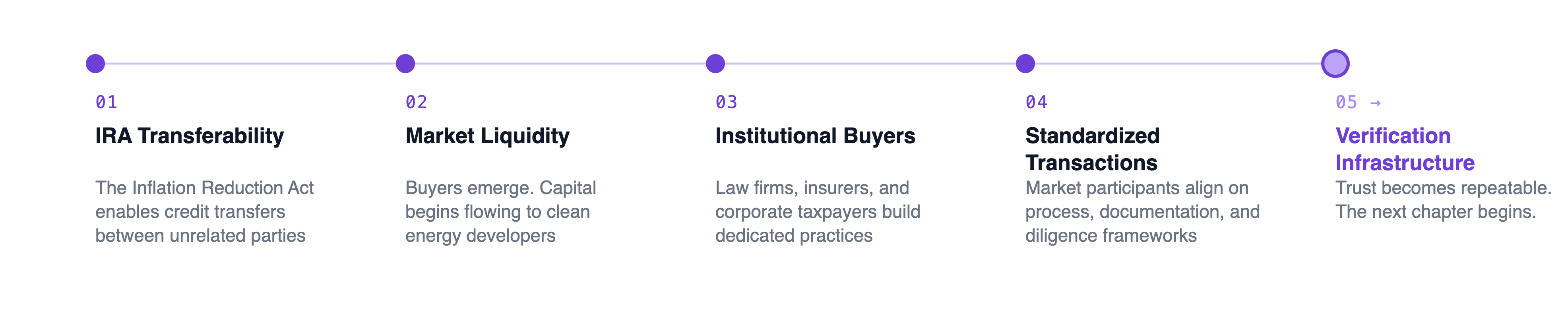
Figure 01 — Market Evolution
Why Deals Slow Down
Most transferable tax credit transactions follow a pattern that will be familiar to anyone who has been through one.
The commercial conversation moves quickly. Pricing is agreed on. Both sides are genuinely interested. Momentum is high.
Then things slow down.
Not because anyone disagrees. Not because the project has a problem. But because everyone involved has to spend weeks — sometimes months — answering the same underlying question: Can we trust this project?
Engineering reports get reviewed. Tax opinions get analyzed. Financial statements get revisited. Questions go back and forth. Documents get updated. More information gets requested. The process grinds forward.
Every participant in that process is doing something rational. They are trying to reduce uncertainty before they commit capital. The problem is not that the process exists. The problem is how much it costs.
Institutional buyers rarely walk away from a project because it is marginally more expensive than a competitor. They walk away because the uncertainty becomes too expensive — too much time, too much risk, too much back-and-forth with no clear end in sight.
Every week added to due diligence is a week of execution risk. And execution risk has a price.
The Industry Doesn't Have a Documentation Problem
Here is something worth sitting with: most projects already have documentation. Engineering reports. Financial statements. Appraisals. Legal opinions. Construction contracts. Insurance policies. The documents exist.
So why does the process still take so long?
Because documentation and verification are not the same thing.
A data room answers one question: Where is the information? It is a filing cabinet. It tells you where things are. It does not tell you whether the assumptions in those documents are sound, which version of a report is current, how the evidence across multiple documents connects, or whether another buyer has already worked through the same questions.
Documents store information. Verification creates confidence.
That is the gap. And as institutional capital continues to flow into this market, that gap becomes more expensive to leave open.

Figure 02 — Documentation vs. Verification
Every Financial Market Has Been Here Before
This is not an unfamiliar moment in the history of financial markets. In fact, it is a remarkably familiar one.
Capital markets built exchanges to standardize how securities were bought and sold. Payment networks built global infrastructure to make transactions reliable across borders. Commercial lending built standardized underwriting so that a loan application in one city could be evaluated using the same framework as one in another. Insurance built common risk frameworks so that policies could be compared and priced consistently.
In every case, the pattern was the same. Markets don't become more efficient because participants suddenly decide to trust each other more. They become more efficient because trust gets built into the infrastructure — so that every new transaction doesn't have to rebuild trust from scratch.
The transferable tax credit market is beginning that same transition. The first generation of the market focused on enabling transactions. The next generation will focus on making those transactions easier to complete.
That requires infrastructure that reduces the cost of trust — not another marketplace, not another data room, but something that makes confidence itself more scalable.
The Next Competitive Advantage
For most of this market's short history, developers have competed primarily on pricing. That will not stop being true. But increasingly, the developers who win will be the ones who compete on certainty.
The projects that close first will not necessarily be the cheapest. They will be the easiest to evaluate.
Every week removed from a due diligence process reduces execution risk. Lower execution risk attracts more buyers. More buyers improve liquidity. Better liquidity benefits every participant in the market.
Trust compounds.
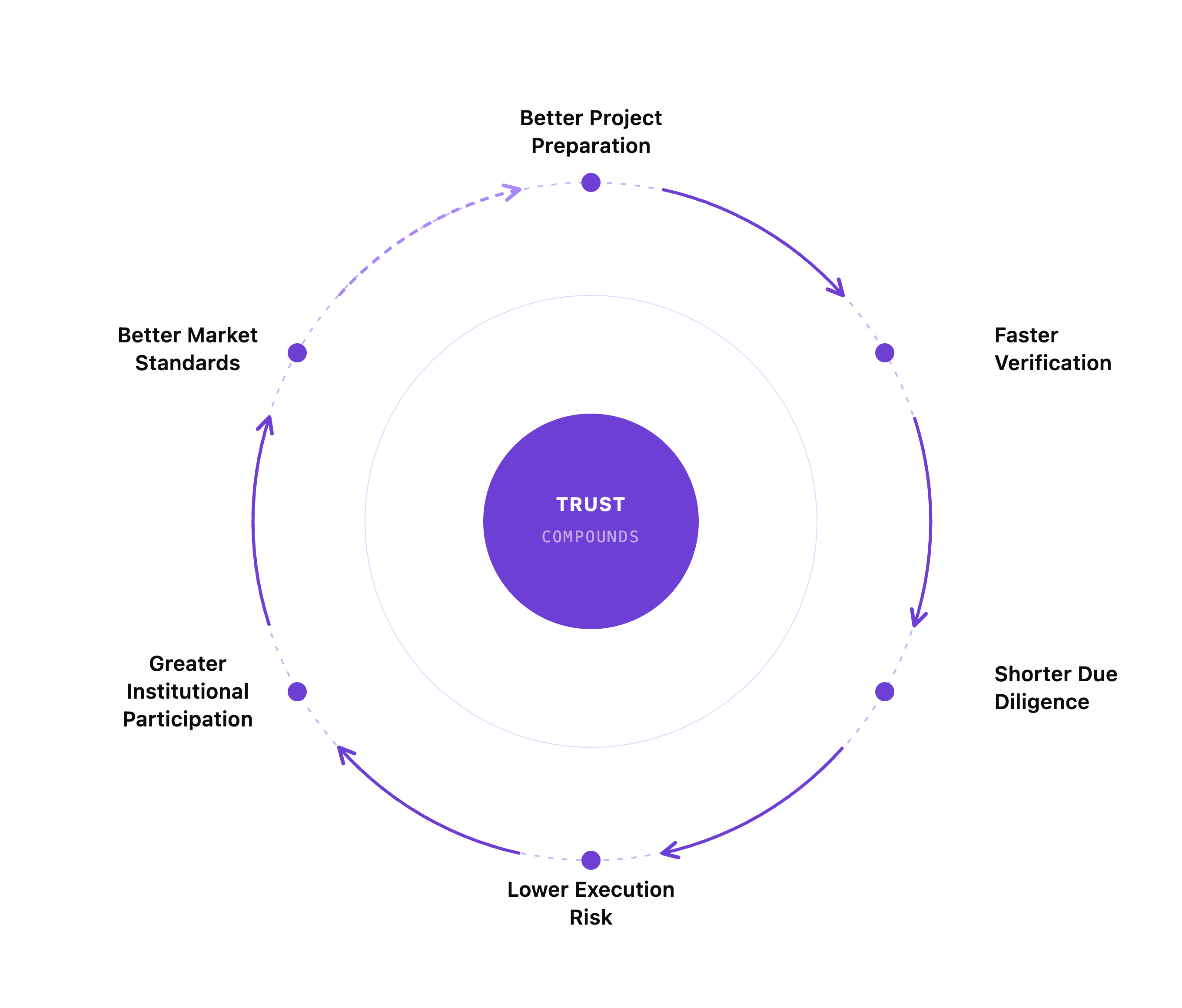
Figure 03 — The Trust Flywheel
Making Trust Scalable
We believe the transferable tax credit market has reached the moment that every maturing financial market eventually reaches — the point where growth has created enough complexity that friction can no longer be absorbed by the participants alone.
The future of this market will not be defined by who originates the most projects or who operates the largest marketplace. It will be defined by who makes trust scalable.
Verification should not begin when a buyer opens a data room. It should begin much earlier — when a project first starts preparing for institutional capital. The earlier that verification happens, the less expensive the entire process becomes for everyone involved.
Markets mature when trust becomes repeatable. That is the next chapter of this industry.
Key Takeaways
The transferable tax credit market has largely solved its liquidity problem. Capital and demand both exist.
The next challenge is reducing the cost of trust — the friction that slows down every transaction after the commercial terms are agreed.
Institutional buyers are not buying documents. They are buying confidence that a project is what it claims to be.
Verification is becoming part of the market's infrastructure, not just a step in each individual deal.
The projects that are easiest to trust will increasingly be the easiest to finance.